In the last few years, we’ve seen more and more Indonesian SMEs adopting digital systems: from POS at the cashier, stock apps, to selling through online channels. The pandemic accelerated this shift, but the reasons go beyond just following a trend.
Digitalization allows small businesses to play at a more serious level: clearer data, more efficient processes, and owners who are no longer trapped in day-to-day operational work.
In this article, we’ll discuss:
- Realistic stages of the SME digital journey
- Why not every business needs a very complex system right away
- Concrete differences between digital vs manual operations
- What risks you face if you keep delaying digitalization
Why SMEs Need to Start Going Digital
Some signs that it’s time for your business to move to a more modern system:
- Sales are growing, but your margins feel like they’re “leaking” without a clear explanation
- Stock discrepancies happen often, especially as branches start to grow
- Sales and financial reports are always late and inconsistent
- The owner can’t stay away from the store for long because everything depends on on-the-spot decisions
Digitalization is not about replacing everything with apps. At its core, it’s about:
Recording and managing your business in a more consistent, measurable, and reliable way.
The SME Digital Journey: One Step at a Time
Not every SME needs to jump straight into a full ERP or a complex custom system. A healthier approach is to see digitalization as a gradual journey.
Here’s a simple illustration:
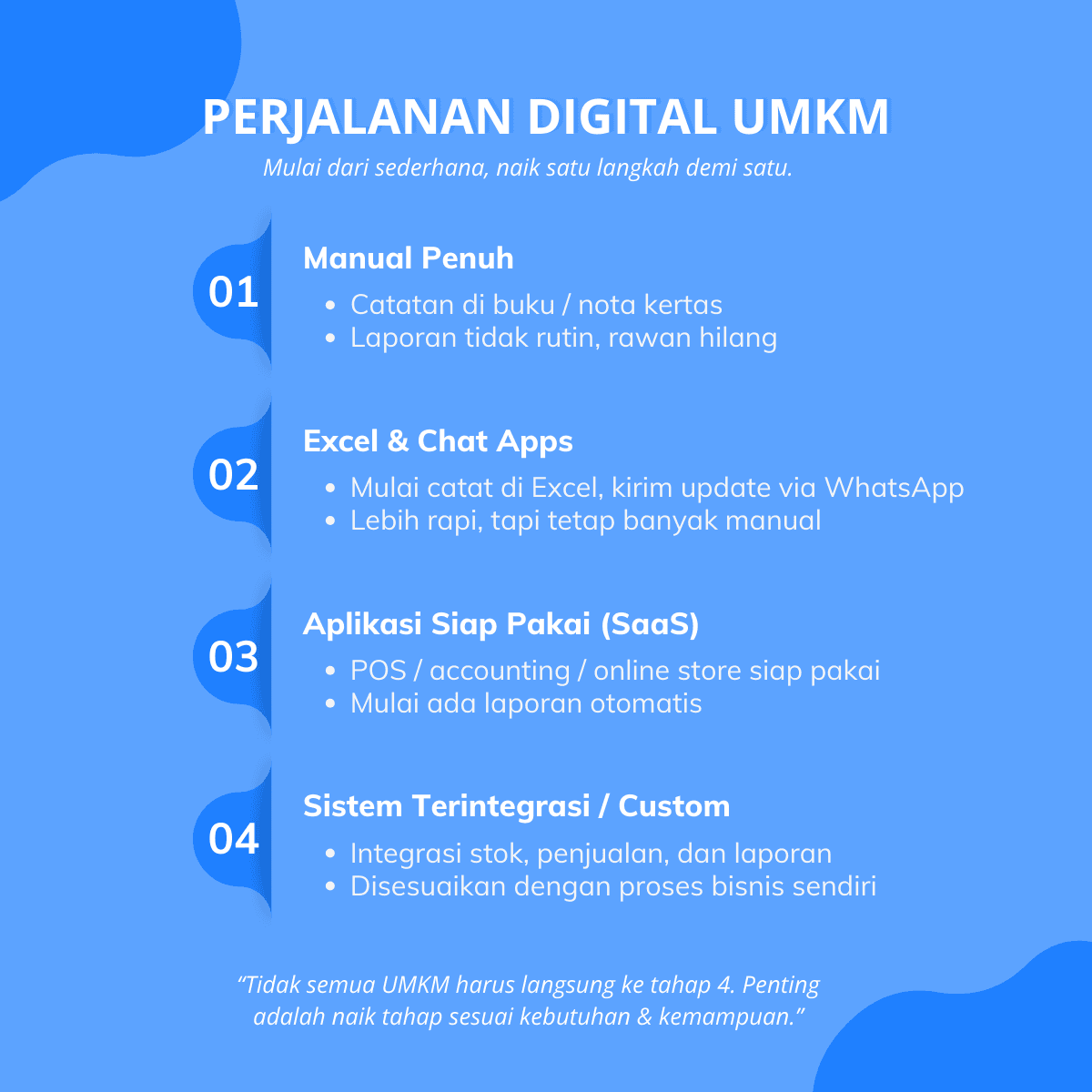
1. Fully Manual
- Records kept in notebooks or paper receipts
- Reports are irregular and easy to lose
At this stage, owners mostly rely on memory and gut feeling. The business can still run, but it’s hard to grow in a structured way.
2. Excel & Chat Apps
- Start recording in Excel and sending updates through WhatsApp
- More organized than notebooks, but still a lot of manual work
This stage is very common. The challenge is scattered files, multiple versions, and difficulty consolidating data across branches or time periods.
3. Off-the-Shelf Apps (SaaS)
- Using ready-made POS, accounting, or online store solutions
- Automatic reports become available and accessible anytime
This is usually the turning point. Data starts flowing into more standardized systems. Owners can see revenue, best-selling products, and outlet performance without opening countless files.
4. Integrated / Custom Systems
- Stock, sales, and reporting are integrated into a single system
- Tailored to your own business processes and long-term needs
This stage is relevant for businesses that have reached a certain scale, have unique processes, or aggressive expansion plans.
Not all SMEs need to rush to stage 4. What matters is progressing step by step according to your needs and capabilities — not just following trends.
Digital vs Manual: What Changes for SMEs?
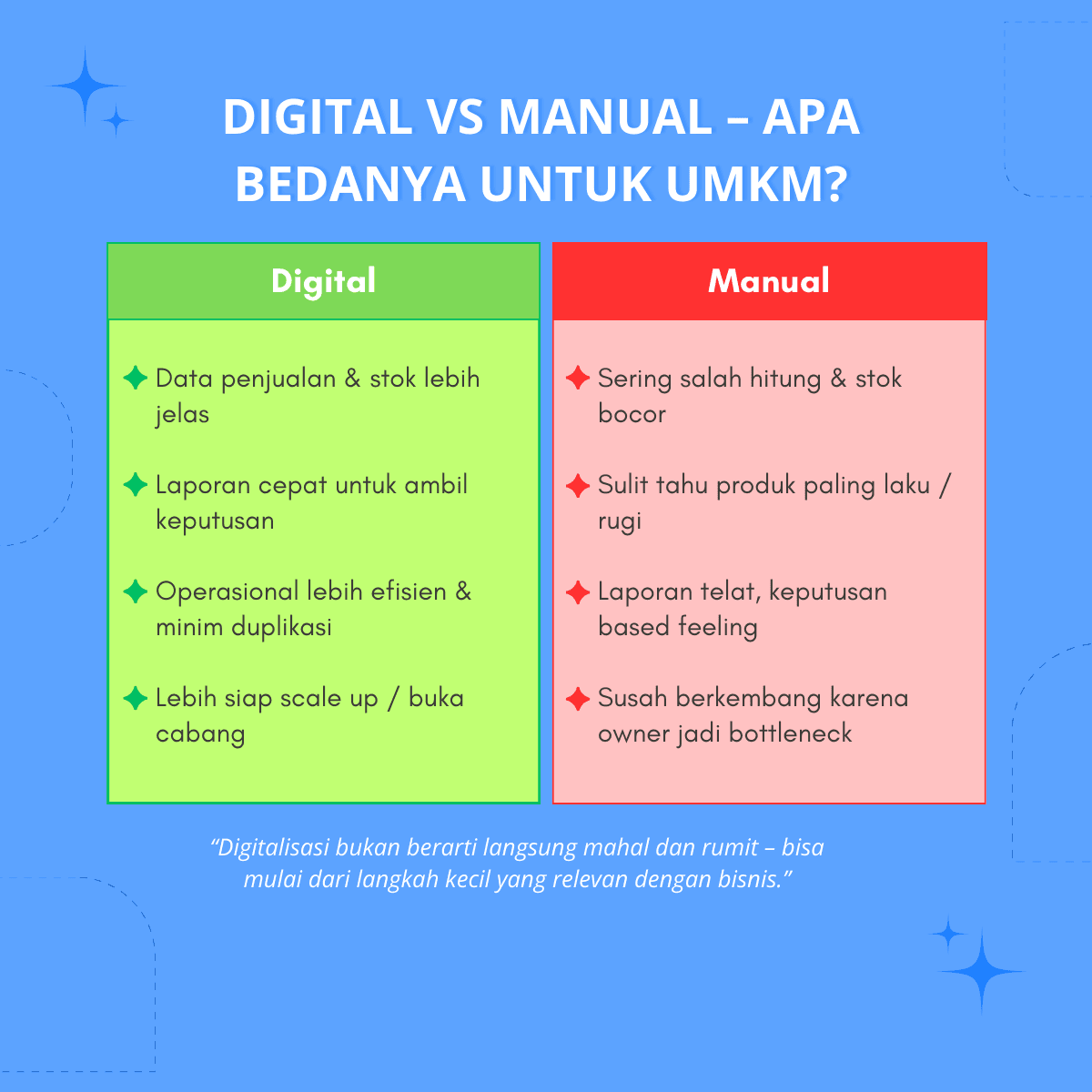
To make it more concrete, here’s a brief comparison between the benefits of digitalization and the risks of staying manual. You can also see this visually in the graphic below:
If You Go Digital
Some of the benefits typically felt:
-
Clearer sales and stock data
You’re looking at numbers, not just relying on gut feeling. -
Faster reporting for decision-making
You can evaluate which menu, product, or branch deserves optimization. -
More efficient operations with less duplication
Data is entered once, then reused for stock, reporting, and analysis. -
More prepared to scale or open branches
A structured system makes adding new outlets much easier.
If You Stay Manual
On the other hand, when a business delays digitalization for too long:
-
Frequent miscalculations and stock leakage
Stock discrepancies become “normal” and are hard to trace. -
Hard to know which products are profitable or loss-making
Pricing and promo decisions become less data-driven. -
Late reporting and decisions based on feeling
Owners only discover the business condition after things have already happened. -
Growth is limited because the owner becomes a bottleneck
Every important decision must go through the owner, making the business difficult to delegate or scale.
Digitalization doesn’t have to be expensive or complicated from day one. The key is to start moving critical records into a cleaner, more consistent system.
Common Reasons SMEs Delay Digitalization
Here are some reasons we often hear when talking with SME owners:
- “I’m afraid it will be too complicated and disrupt staff workflow.”
- “We don’t have anyone handling IT yet.”
- “I’m worried about choosing the wrong system and wasting money.”
- “We can still manage things manually for now, so it’s not a priority.”
These concerns are valid. The solution is not to force a massive overnight rollout, but to:
-
Start with the most critical process
For example: cashier sales, raw material stock, or receivables tracking. -
Choose solutions you can test on a small scale first
You can start with SaaS, then evaluate after a few months. -
Involve your team from the beginning
Explain the direct benefits for them: less repetitive work, fewer mistakes. -
Ensure proper support and guidance
From vendors, consultants, or internal champions responsible for the system.
A Realistic Strategy for Going Digital
Here’s a practical approach we often recommend:
-
Map your core business processes
For example: purchasing, sales, stock, finance, and management reporting. -
Pick 1–2 areas with the highest impact
Often this is POS + stock, or sales + finance. -
Start with the simplest credible solution
It could be off-the-shelf SaaS, or a combination of tools that work well together. -
Collect data for at least 3–6 months
Use this period to understand sales patterns, team behavior, and system weaknesses. -
Plan integration or custom systems if needed
Once you know what actually works, then consider integrated or custom systems.
This approach makes digitalization a measured journey instead of a speculative leap.
How We Can Support Your Digitalization Journey
At Sono Next-Gen Solutions, we help SMEs and growing businesses to:
- Identify current conditions and operational pain points
- Define a realistic digitalization strategy: from selecting SaaS tools to designing custom systems
- Build solutions like POS, dashboards, and inventory systems that fit into your daily workflows
- Develop long-term roadmaps so technology investments stay aligned with your growth plans
If your business is at a crossroads between staying manual or going digital, you don’t have to figure it all out alone. With proper mapping and thoughtful steps, digitalization can become a solid investment that strengthens your business — not just a trend you’re trying to keep up with.